Why this meeting matters more than the monthly performance report
In Egyptian e-commerce, especially with cash on delivery, campaign numbers alone cannot tell you whether a media buyer is succeeding. A campaign can bring many orders at a low cost, and then the confirmation team discovers that a large share are not serious, have wrong numbers or incomplete addresses. The result: the real cost per delivered order is far higher than the number in the ads dashboard.
A weekly meeting between the media buyer and the order confirmation team is the link between what happens in the campaign and what happens on the first call with the customer. Its goal is not to swap news, but to make specific decisions every week: which campaign to scale, which to stop, which audience or creative brings weak orders, and which message on the landing page needs to change.
Without this meeting each team works on its own island: the media buyer optimizes metrics that do not reflect profit, and the confirmation team carries the pressure of orders that cannot be fulfilled. With a structured meeting, order quality becomes part of the media decision, not a complaint raised too late.
Who attends, how long, and when
A good meeting is small and focused. Core attendees: the media buyer who owns the account, one or two people from the confirmation team, and the e-commerce lead or the commercial decision maker. The shipping lead can join when discussing cancellations after confirmation, but not every week.
Suggested length: 30 to 45 minutes. Hold it on a fixed day after the confirmation team has processed the previous days’ orders, so the data is fairly stable. Any meeting that runs over an hour without written decisions needs its agenda reviewed.
One important rule: no discussing a single customer’s issue unless it reveals a repeated pattern. The meeting is not where complaints are solved; it is where patterns are read and decisions are made.
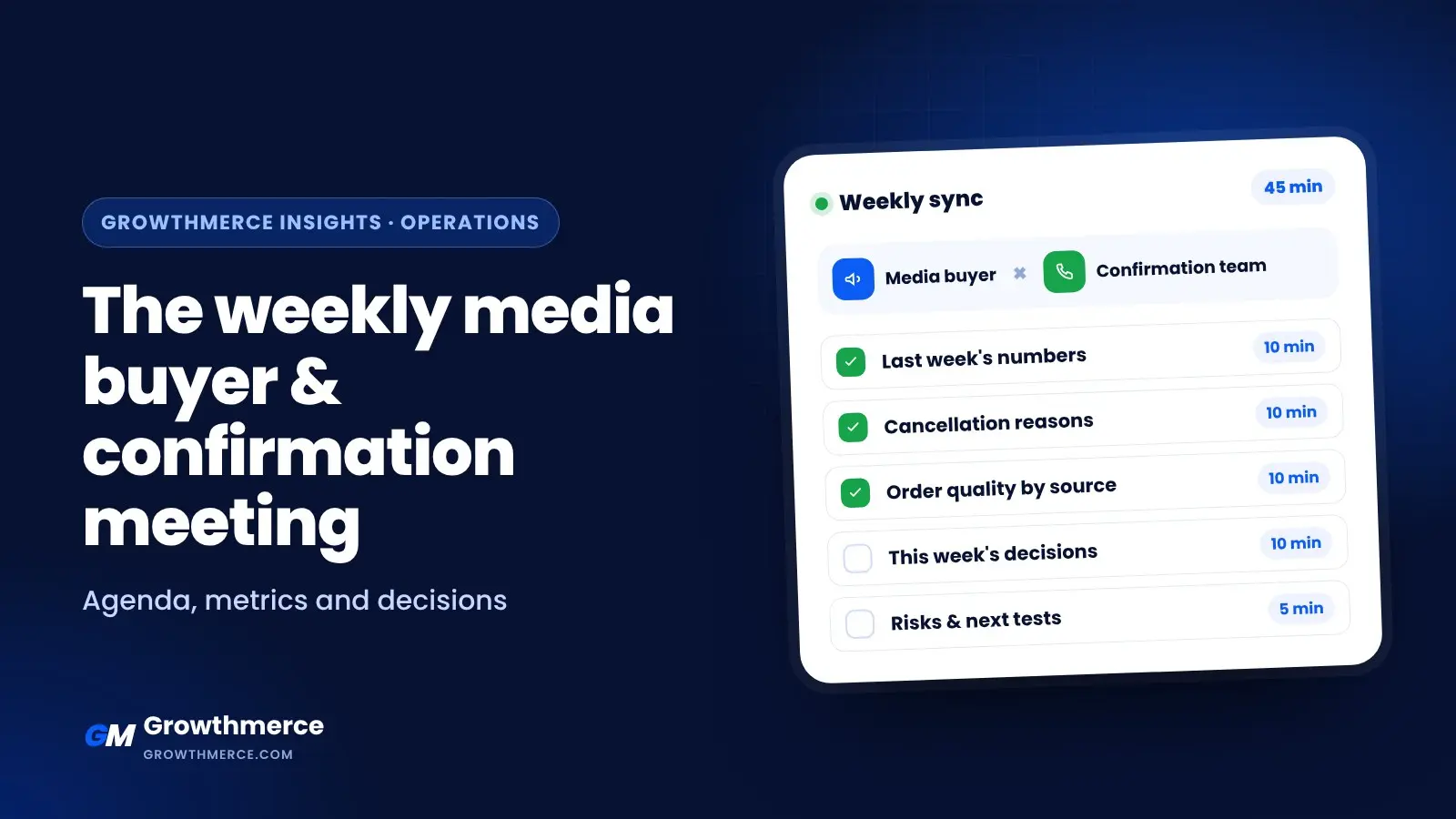
The suggested agenda: five items, no more
1. Last week’s numbers (10 minutes)
Show the numbers on one screen: orders, confirmed orders, orders cancelled before shipping, delivered orders, and cost per confirmed and delivered order for each main campaign. Do not show many numbers, only what serves the decision. Read them against the previous week, not in isolation. To keep the comparison fair, separate order creation date from delivery date: compare order groups that have had enough time to be confirmed and delivered, and do not judge new orders as undelivered.
2. Cancellation and rejection reasons (10 minutes)
The confirmation team presents the top cancellation reasons: wrong number, customer did not order, unclear price, unsuitable delivery time, duplicate order, or doubts about seriousness. Classify reasons into what media can fix (message, audience, creative) and what confirmation or shipping must fix.
3. Order quality by source (10 minutes)
Link each campaign or ad set to its confirmation and delivery rate. A campaign that brings many orders with a low confirmation rate is not necessarily a success. The discussion is technical and direct: is the problem the ad promise? The audience? The landing page? An unclear price or delivery time?
4. This week’s decisions (10 minutes)
Write every decision clearly: what we do, who owns it, and when it is reviewed. Examples: pause an ad set, edit ad copy, add a clarifying question on the landing page, change an audience segment, or reallocate budget.
5. Risks and upcoming tests (5 minutes)
A quick look at what will be tested next week and what needs support from the confirmation team, such as trying a new message or a different offer. Agree tests in advance so they do not become random experiments.
The metrics worth discussing
Not every number deserves meeting time. Focus on the metrics that link the ad to the business result:
- Confirmation rate: the share of incoming orders that were confirmed.
- Cancellation before shipping: reveals seriousness or clarity problems.
- Delivery rate: the final share that reached the customer.
- Cost per confirmed and delivered order: the number budget decisions should be based on.
- Cancellation reason mix: is the problem in the ad or in the confirmation process itself?
These metrics do not replace reviewing real profit per order, but they give a clearer picture than relying on the initial cost per order alone. For more on linking performance to actual collection, see connecting marketing performance with shipping and collected cash.
A hypothetical example: from discussion to decision
This is an illustration, not real data. Imagine a broad-audience campaign that logged many orders at a low cost, but the confirmation team noticed that a clear share of customers say they did not order or expected a different price. In the meeting, three possibilities come up: the ad copy suggests an offer that does not exist, the landing page does not show the price clearly, or the audience is wrong.
The decision might be: edit the ad copy to state the price and delivery time, add a confirmation question on the landing page, and watch the confirmation rate for a week before any budget increase. The decision is written, the owner is named and the review date is known. That way the discussion does not turn into blame, but into shared improvement.
Before-and-after checklist
Use this list to make sure the meeting produces decisions, not just notes:
- Prepare one report with campaign, confirmation and delivery numbers a day before the meeting.
- Group cancellation reasons into fixed categories so you can compare week to week.
- Pick the top three campaigns or ad sets to discuss, not everything.
- Write every decision as: decision, owner, deadline, how it is measured.
- Review last week’s decisions at the start of every meeting before any new topic.
- Log upcoming tests so they are not repeated or forgotten.
- Send a written summary to all attendees after the meeting.
Common mistakes that ruin the meeting
The first mistake is turning the meeting into a trial of the media buyer or the confirmation team. Success is shared, and the problem is usually the gap between the message and reality. The second is discussing every campaign and every detail, so time runs out without a decision. The third is not documenting decisions, so the same problem returns every week.
The fourth is ignoring the confirmation team’s notes because they are “not numbers”. In fact, these notes are the closest point to the customer and often reveal problems that never show in the ads dashboard. The fifth is holding the meeting without data ready, so it becomes opinions.
What a good meeting looks like
A good meeting ends with a short, clear list of decisions, and everyone knows what to do. The following week those decisions are reviewed first, and their effect on confirmation rate, delivery rate and cost per confirmed order is measured. Over time the meeting becomes a small operating system that links the ad to the final customer and bases budget decisions on order quality, not just volume.
If you want to build this system inside your team or with an outside partner, book a free call with Growthmerce to discuss connecting your media buyer and confirmation team in one workflow. For more on commercial team roles, see the e-commerce growth team, and for campaign management, see media buying agency in Egypt.