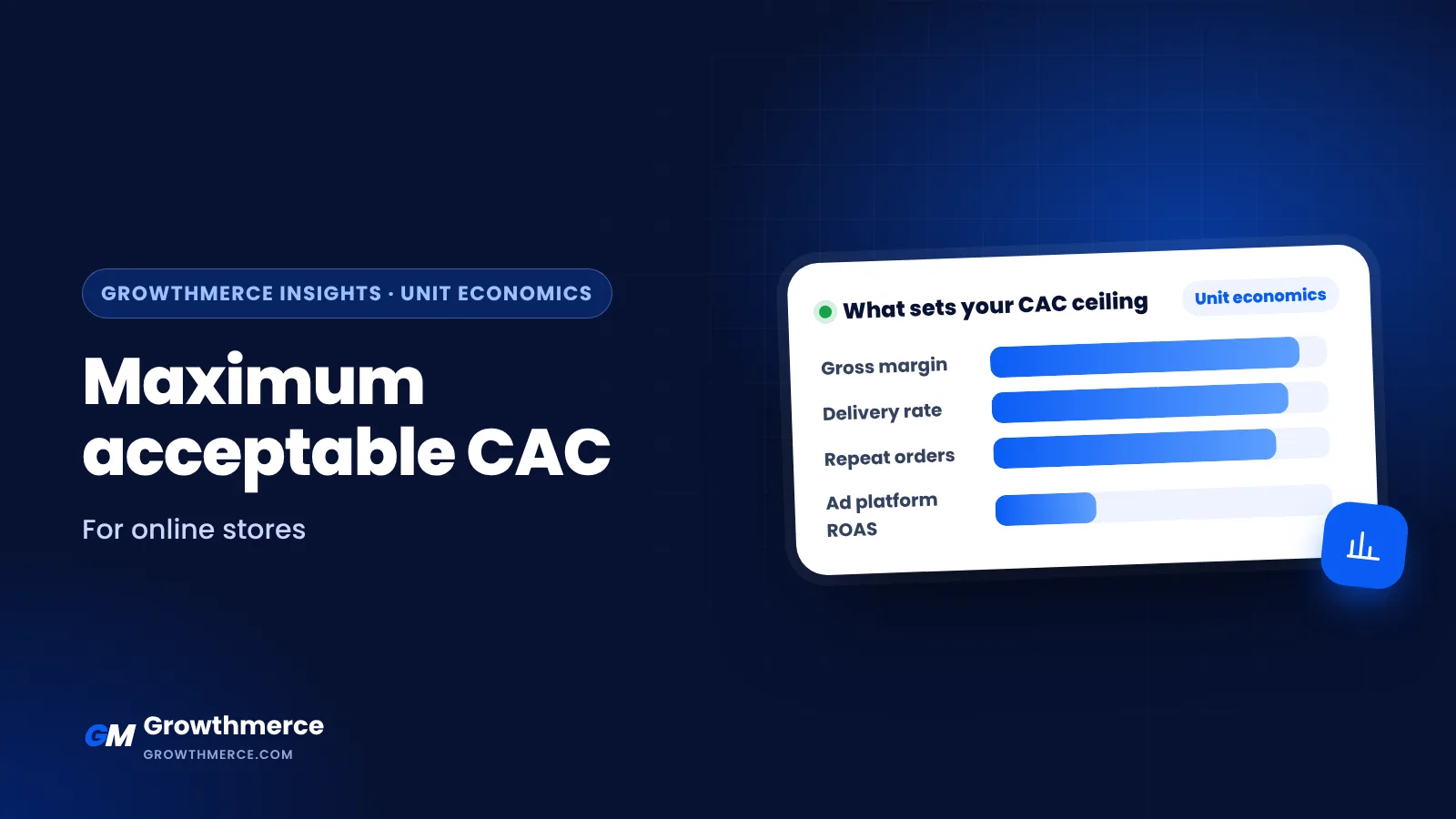
Why your maximum acceptable CAC matters more than the cost itself
Many store owners in Egypt ask one question: “How much does it cost to acquire a customer?” The more useful question is: what is the most I can pay for a customer and still make a profit? The first number tells you what happened. The second tells you what should happen. Without a clear ceiling, decisions to raise budgets or pause campaigns stay emotional.
In this guide we build that ceiling from numbers you already have: your profit margin, your share of completed orders and your operating costs. We do not rely on fixed market benchmarks, because every store has a different cost structure.
Acquisition cost vs cost per completed order
Mixing these two up is the most common mistake. Customer acquisition cost (CAC) is usually measured at the ad or campaign level: how much you spent per customer or order. In Egypt, part of those orders never complete because of cash on delivery, unreachable customers or refused deliveries.
So you need two separate numbers:
- Cost per placed order: total ad spend ÷ number of placed orders.
- Cost per completed order: total ad spend ÷ number of delivered and paid orders.
The second number is the one that decides whether you are really profitable.
How to calculate your maximum acceptable CAC, step by step
1. Calculate your net margin per order
Take the selling price and subtract product cost, shipping, packaging, payment fees and direct operating costs. The result is your net margin before marketing. This is the amount available to pay for acquisition.
2. Account for incomplete orders
If only 70 out of every 100 placed orders are delivered, the profit from 70 orders has to cover the cost of all 100. In practice, multiply your net margin by your completion rate to get the real margin per placed order.
3. Keep part of the margin for profit and growth
Do not spend your whole margin on ads. Keep a share for profit and fixed costs. This is a business decision that depends on your stage of growth.
4. Set the ceiling
Maximum acceptable cost = real margin per placed order × the share you allow for advertising. Any cost above that means you are growing at a loss.
5. Compare with reality every month
Compare your actual cost per completed order with the ceiling. The gap between them is your real room for improvement.
Worked example (hypothetical numbers for illustration only)
A hypothetical clothing store sells an item for 800 EGP. After product cost, shipping, packaging and fees, the net margin is 250 EGP per delivered order. If 70% of placed orders are delivered, the real margin per placed order is 250 × 0.7 = 175 EGP. If the owner allows 60% of that for ads, the ceiling is about 105 EGP per placed order, or 150 EGP per completed order.
Use the ads ROI calculator to run your own numbers, and read break-even ROAS for COD stores.
Practical rules to stay under the ceiling
- Set a maximum share of margin for ads and write it down as an internal policy.
- Review the ceiling whenever prices or shipping costs change.
- Do not compare your cost with other stores without knowing their cost structure.
- Track cost at the ad set and product level, not just the account level.
- Improve your delivery rate with order confirmation. Read how to reduce COD returns.
Common mistakes that push cost above the ceiling
The first mistake is judging a campaign by cost per placed order alone, so performance looks good while real collections are weak. The second is ignoring post-sale costs like exchanges and returns. The third is using one ceiling for all products even though their margins differ.
When the gap is large, diagnose the full path from ad to delivery before raising the budget. Our guide to diagnosing traffic without sales helps you find where you are leaking.
When do you need an outside review?
If your numbers are scattered across ad platforms, order sheets and the shipping company, your calculation will stay an estimate. A unified measurement setup turns your acceptable cost into a number you can trust for budget decisions. Growthmerce builds that setup and manages campaigns against it. Book a free call or see our packages.