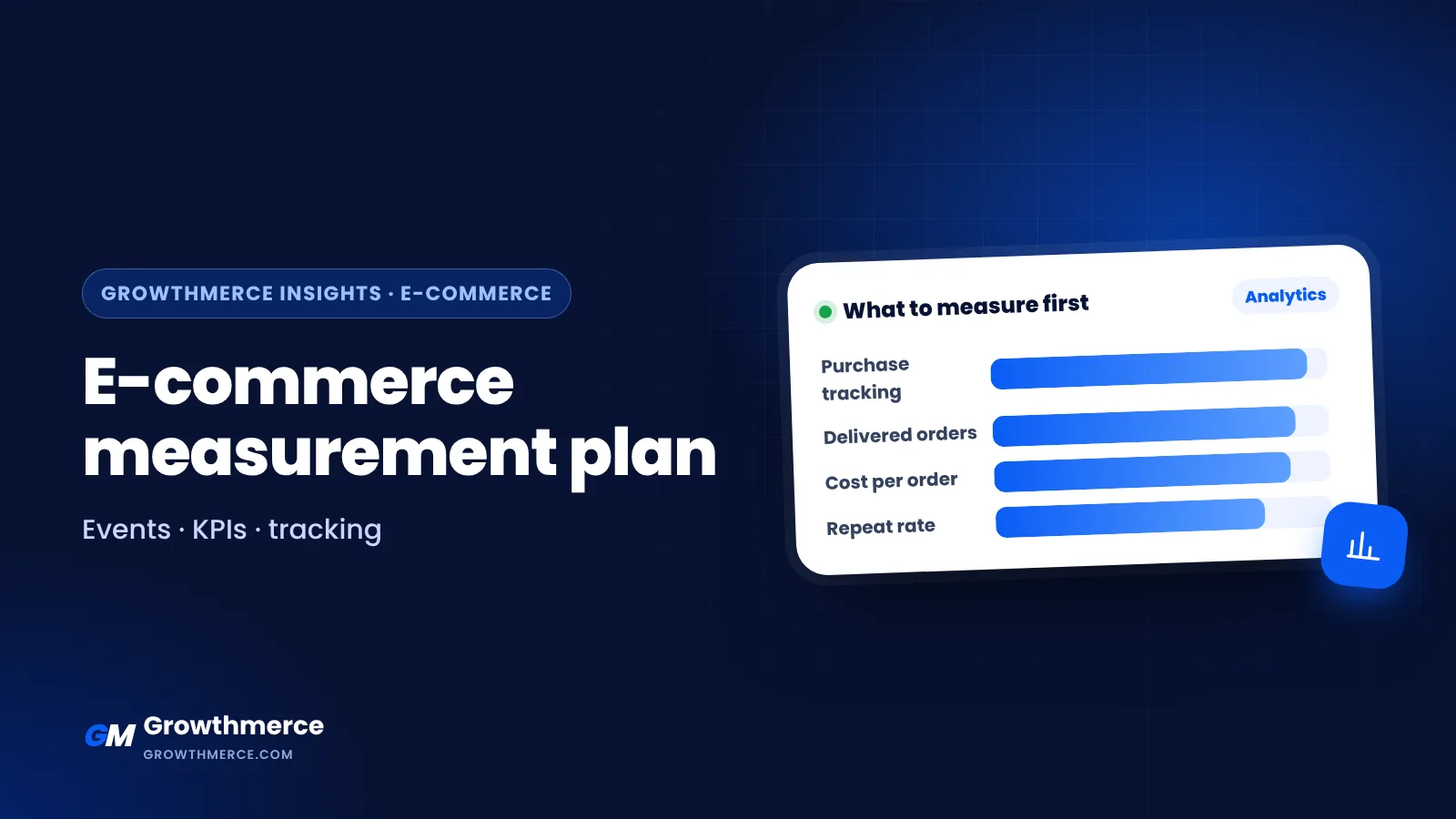
Most Egyptian online stores start a campaign the same way: pick a product, build creative, set a budget, and only then ask how results will be judged. Two weeks later the argument begins. The media buyer points to cheap purchases, the operations team points to cancelled orders, and the finance team points to cash that never arrived. Nobody is lying. They are simply measuring different things.
An ecommerce marketing measurement plan is the document that prevents that argument. It is written before the campaign, agreed by everyone who touches the money, and it defines what success means in numbers you can actually collect. This guide gives you a practical structure you can complete in a single working session.
Why measurement must be designed before launch
Measurement is not a report you build afterwards. It is a set of decisions about what data you will collect, where it lives, and who is allowed to interpret it. Once a campaign is live, you lose the ability to fix certain things cheaply: a missing tracking event, a broken confirmation step, or a definition of “sale” that nobody agreed on.
There is a second reason. In cash-on-delivery markets, the gap between a platform-reported purchase and collected cash is wide. If your plan only measures what the ad platform reports, you will scale campaigns that look profitable and drain cash. If your plan only measures bank deposits, you will be slow to react and unable to see which creative or audience produced the result. A good plan connects both ends of that chain.
Finally, a written plan protects the relationship with your agency or media buyer. Clear definitions of a qualified order, a reporting window, and an acceptable cost per delivered order turn performance conversations from opinion into arithmetic.
Step 1: Define the business goal in one number
Start with the outcome the business needs, not the metric the platform offers. Write one primary goal and one guardrail metric. Examples of primary goals: number of delivered orders per month, contribution profit after ads and shipping, or new customer count. The guardrail is the number that must not break while you chase the primary goal, such as return rate or cost per delivered order.
Then translate the goal into a target you can defend. If you know your average order value, product cost, shipping cost, and expected return rate, you can estimate the maximum you can pay to acquire a delivered order. That figure becomes the ceiling for every campaign decision. If you have not calculated it yet, our guide on calculating the true profit of an e-commerce order walks through the components.
Hypothetical example, clearly illustrative: a store selling home goods sets a target of 400 delivered orders per month. Average order value is 900 EGP, product and packaging cost 400 EGP, delivery and return costs average 120 EGP per delivered order, and ads are the only variable cost left. The contribution before ads is roughly 380 EGP per delivered order, so the team sets a working ceiling well below that to leave room for overhead. The exact numbers are yours to fill in; the structure is what matters.
Step 2: Map the funnel and choose the events you will track
You cannot manage a funnel you have not drawn. List every stage from first impression to collected cash, and decide which events you will record at each stage. Keep the list short enough that it is actually maintained.
- Attention: impressions, reach, video views, cost per thousand impressions.
- Interest: landing page or product page views, add-to-cart, initiate checkout.
- Order placed: the platform-reported purchase, with its value.
- Order confirmed: the order survived your confirmation step, whether by phone, WhatsApp or automated flow.
- Order shipped: handed to the courier.
- Order delivered: cash collected or payment settled.
- Repeat purchase: a second order from the same customer within a defined window.
Each event needs an owner, a source of truth, and a definition. “Confirmed order” is meaningless until someone writes down what confirmation means in your operation. For a deeper look at the tracking layer, see our GA4 events checklist and the pixel and conversions API checklist.
Step 3: Build the cost and quality metric set
Platform metrics describe delivery of impressions and clicks. Business metrics describe money. Your plan should contain both, with the business metrics treated as the decision layer.
Metrics worth defining in writing
- Cost per order placed versus cost per order delivered: the second is the one that pays salaries.
- Confirmation rate: confirmed orders divided by orders placed.
- Delivery rate: delivered orders divided by shipped orders.
- Return rate: returned orders divided by shipped orders, tracked by governorate and by courier where possible.
- Contribution per delivered order: revenue minus product, packaging, shipping, returns and ad cost.
- Repeat rate: share of customers ordering again within your chosen window.
Write the formula for each metric in the document. A metric without a formula is an opinion. If two people calculate return rate differently, every meeting becomes a debate about arithmetic instead of a decision about budget.
Step 4: Set the reporting rhythm and the decision rules
Decide in advance how often you will look, at what, and what you will do with what you see. A simple rhythm works for most stores:
- Daily: spend, orders placed, confirmation queue, and any tracking failure. This is a health check, not a strategy meeting.
- Weekly: cost per confirmed order, delivery rate by courier, creative performance, and budget pacing against the plan.
- Monthly: contribution per delivered order, return rate by product and governorate, repeat rate, and a written note on what changed and why.
Then write decision rules. For example: if cost per delivered order exceeds the ceiling for two consecutive weeks with stable delivery rates, pause the weakest creative set and review the offer. If delivery rate drops in one governorate, investigate the courier before touching the ads. Rules written in advance stop panic edits and protect the learning period a campaign needs.
Our guide on connecting marketing performance with shipping and collected cash explains how to join these datasets in practice.
Pre-launch measurement checklist
Work through this list before the first pound of ad spend leaves the account.
- One primary goal and one guardrail metric written down and signed off by the owner.
- Maximum acceptable cost per delivered order calculated from real cost inputs.
- Funnel stages listed, with an owner and a definition for each event.
- Purchase, add-to-cart and lead events tested end to end on mobile, including the confirmation step.
- Order data flowing into one place where ad spend and delivery status can be joined.
- Metric formulas documented, including return rate and confirmation rate.
- Reporting cadence and meeting attendees agreed.
- Decision rules written for the three most likely scenarios: cost too high, delivery rate falling, volume too low.
- A named person responsible for data quality, with a weekly check.
- A baseline period recorded before launch so you can compare later.
Common mistakes that quietly break measurement
The most frequent failure is measuring only the platform’s purchase event and calling it revenue. The second is changing campaign structure and creative at the same time, which makes it impossible to know what caused the change. The third is reporting on a window so short that deliveries have not happened yet, which flatters performance and hides return problems.
Two more deserve mention. Teams often track too many metrics and act on none of them; a short list with clear owners beats a dashboard nobody reads. And definitions drift: someone starts counting cancelled orders as returns, and month-over-month comparisons become meaningless. Review the definitions document quarterly and version it.
If a number cannot change a decision, it does not belong in the weekly report.
Where to start this week
You do not need a data warehouse to begin. Take one product line, write the goal, calculate the ceiling cost per delivered order, list your funnel events, and confirm that order status data reaches the same sheet as your ad spend. That single loop, repeated weekly, will outperform any elaborate dashboard built after the money is spent.
If you want help designing the measurement layer and the reporting rhythm around your campaigns, talk to the Growthmerce team. We build the plan with your operations and finance reality in mind, then run campaigns against it.