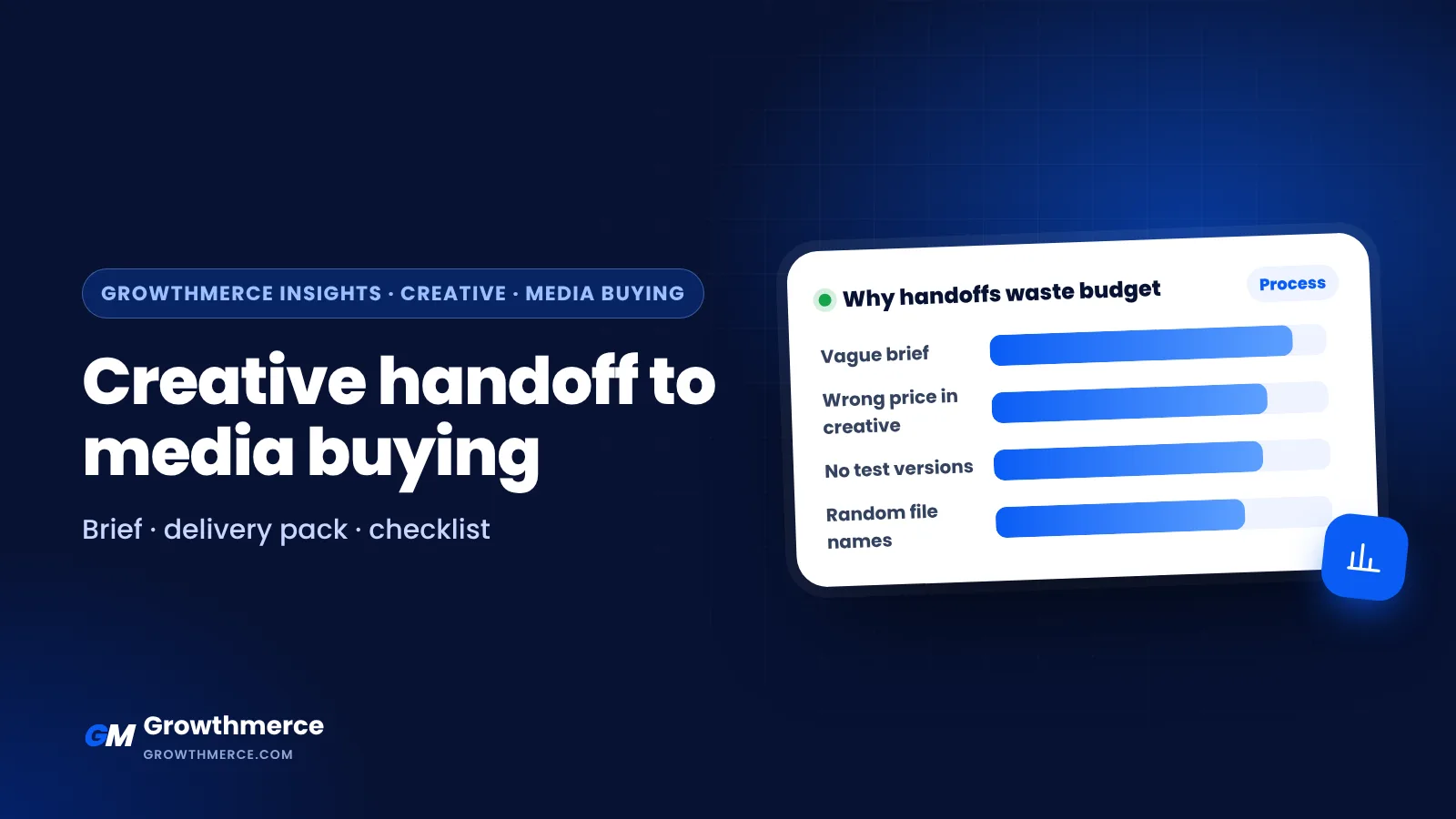
Short answer: Most campaign delays and wasted budget do not come from bad design. They come from a messy handoff: creatives sent late on WhatsApp, wrong sizes, an old price, no short version for testing and no written copy. Fix it with clear roles, a brief that answers the key questions before design starts, a fixed delivery pack, one naming rule, a pre-launch checklist and a weekly feedback loop from results back to the creative team. Growthmerce runs creative production and media buying as one team, so creatives are built for testing from day one. See creative production, our packages or book a free call.
Key takeaways
- The handoff is part of campaign performance, not an admin step.
- One person must own the handoff, even in a small team.
- A good brief answers goal, audience, angle, offer, call to action, sizes and deadline.
- Agree on a fixed delivery pack: source files, final versions, alternatives, written copy, usage notes and a change log.
- One naming rule prevents uploading the wrong file.
- Review against a checklist before launch, and feed results back to designers every week.
Why creative handoff turns into a problem
In many Egyptian and Gulf stores, the design team makes good creatives and the media buyer receives them on WhatsApp or Drive at the last minute. The campaign is delayed, launched with the wrong file, or paused after two days because the size is wrong or the message is unclear. The problem is not the design. It is the handoff process.
Every incomplete file means lost time, and every unnecessary duplicate means budget spent on a test that teaches nothing. This guide gives you a process you can apply from tomorrow, whether your team is in-house or works with an agency.
Who owns what
| Role | Responsibility |
|---|---|
| Media buyer | Sets the angle, message, goal, sizes and number of versions; receives and reviews before launch |
| Designer or content creator | Produces the creatives from the brief and prepares files with the agreed names |
| Store or brand owner | Approves message, price and offer; checks they match store policy |
| Operations or customer service | Confirms what the creative shows is really available: sizes, colours, delivery time, payment method |
When roles are clear, handoff is faster and revisions drop. In a small team the same roles can sit with two people, but one person must own the process.
The brief: the most important page before any design
Most rework happens because the brief was incomplete. A good brief answers these before the designer opens any software:
- Goal: direct sales, messages, store visits or brand awareness?
- Audience: who are we talking to, and what is their biggest objection?
- Angle: benefit, price, problem or social proof?
- Offer: what exactly appears in the creative, and what must not be mentioned?
- Call to action: what should the viewer do next?
- Sizes and formats, and the number of versions per angle.
- Deadlines: final delivery and review time before launch.
See the brand brief every creative team needs and UGC content briefs that produce better ads.
The delivery pack: what must arrive every time
Instead of receiving “some pictures”, agree on a fixed pack that repeats every campaign:
| Item | Why it matters |
|---|---|
| Source files | Change text or price without redesigning |
| Final ready versions | Correct formats for each platform, clearly named |
| Alternative versions | A version with less text and a shorter version for testing |
| Written copy | Hook, headline, description and call to action in a separate file |
| Usage notes | Which version is for which audience or occasion |
| Change log | What changed from the previous version and why |
This pack lets the media buyer build a real test, not just upload files. For test structure, see a practical creative testing system and Meta ads creative testing.
Naming and folders: small details that save hours
Random names are the first reason someone uploads the wrong version. Agree on one rule, for example: campaign_angle_audience_size_version. The exact rule matters less than everyone using it.
Organise the delivery folder like this:
- A folder for the current campaign and an archive for finished ones.
- Separate folders for copy and for source files.
- One summary file: date, number of versions, angles and notes.
Pre-launch checklist
Before the media buyer receives the files, one person checks:
- Text is readable on mobile without zooming.
- Price and offer match what is live in the store.
- Product, size and colour match the image.
- No promises you cannot deliver and no unsupported claims.
- The call to action is clear in one second.
- Files follow the naming rule and sit in the right folder.
- Alternative versions are ready for testing.
- There is enough time to review before launch.
If anything is uncertain, delay the launch rather than fix it after budget is spent. For seasonal campaigns, see the White Friday store setup checklist.
Example: how a bad handoff costs money
This example is hypothetical, not data from a real campaign.
A clothing store launches a new product. The team prepares 6 images but no short-text version and no separate copy file. The media buyer uploads them, and two days later notices the text is too long on mobile and one image shows an old price. The campaign is paused, images are redesigned and launch is delayed. With a short version, a copy file and a change log, that time would have been saved.
The lesson is not that the team is bad. The process was open to personal interpretation. When the handoff has a fixed shape, mistakes drop.
The weekly feedback loop
Handoff should run both ways. Every week, the media buyer shares with the creative team:
- The top 3 creatives by cost per delivered order, not by likes.
- Which hooks held attention in the first 3 seconds.
- Which angles failed and the likely reason.
- What to make next week: new angles, new formats or variations of winners.
This turns design from guessing into a process that learns from results.
How Growthmerce helps
- Creative production and media buying in one team, with one brief.
- Fixed delivery packs and naming built for testing.
- Creative testing on Meta, TikTok and Snapchat with weekly feedback.
- Reporting by delivered orders, not likes or reach.
Compare our packages or book a free call to review your current handoff and creative testing.