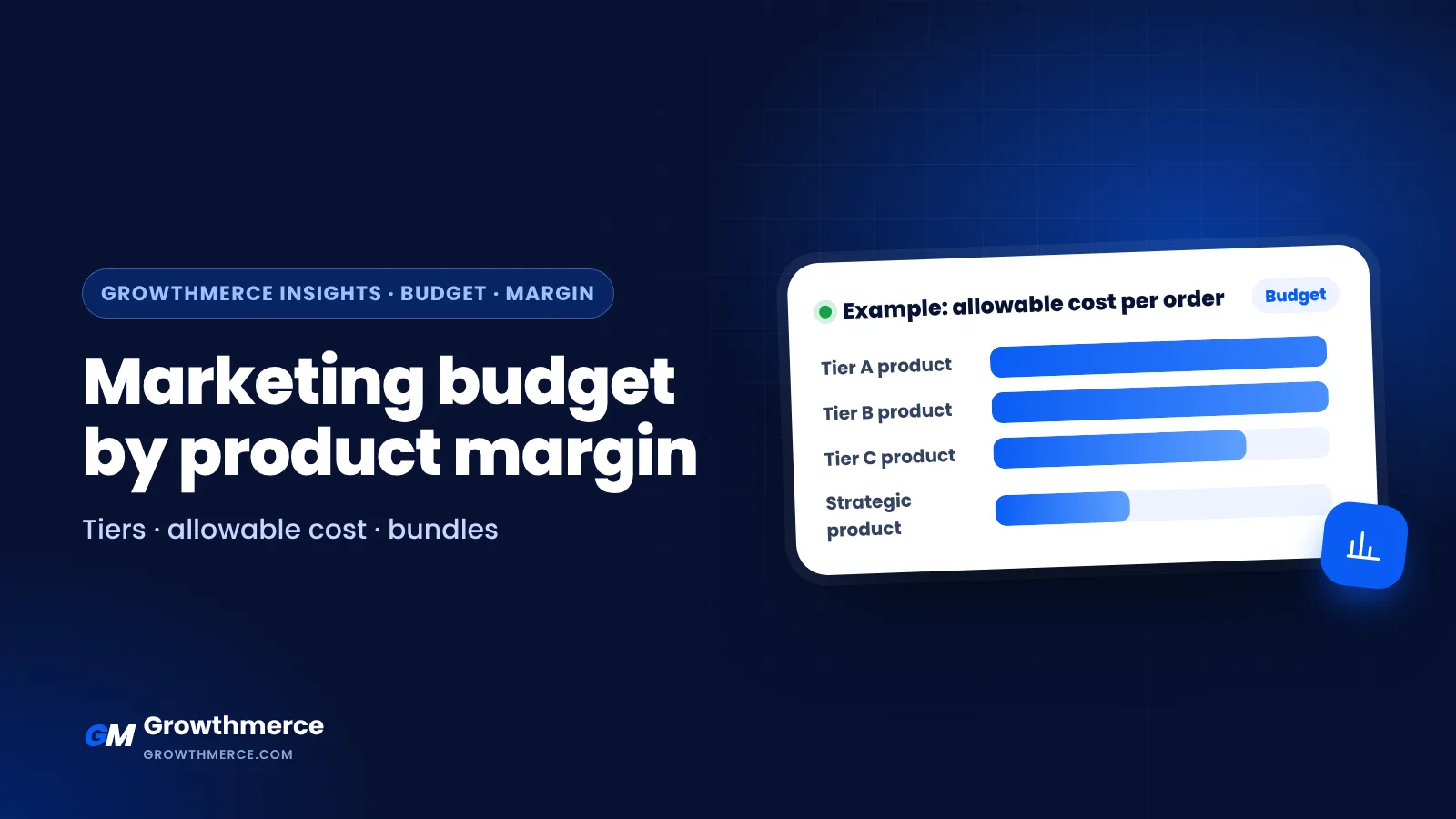
Short answer: When your products have different gross margins, one budget number and one ROAS target will quietly push spend toward products that are easy to sell instead of products that make money. Plan instead at product-group level: sort products into margin tiers, set an allowable ad cost per delivered order for each, give each tier its own share of the budget, use bundles to lift margin per order, and review weekly against tier targets. Growthmerce builds margin-aware ad budgets for e-commerce brands and reports by delivered orders and profit. See performance marketing, our packages or book a free call.
Key takeaways
- ROAS measures revenue, not profit. Two products with the same ROAS can leave very different money behind.
- Group your catalog into 3 or 4 margin tiers before you plan any budget.
- Replace “target ROAS” with “allowable ad cost per delivered order” for each product or tier.
- Split the budget into a protected base, a testing reserve, a capped low-margin tier and deliberate strategic spend.
- Bundles raise margin per order without raising ad cost per order.
- Review weekly by tier and watch the blended margin of the orders you generated.
Why one blended ROAS target hides the real problem
ROAS compares revenue to ad spend. It says nothing about what is left after product cost, shipping, packaging, payment fees and returns. Two products can both return 3 times their ad spend and produce very different profit.
When the whole account runs on one ROAS target, the platform and your team naturally push the products that are easiest to sell, not the ones that fund the business. High-margin products may be underfunded because they need more creative work or a longer decision time. Low-margin products may absorb budget because their conversion rate looks healthy.
The fix is to plan at product or product-group level, then add the groups up into one budget. For the underlying math, see the break-even ROAS guide and what ROAS means.
Step 1: Group products into margin tiers
You do not need perfect cost accounting to start. You need a reasonable estimate of gross margin per product: selling price minus product cost, and ideally minus shipping and packaging where you can attribute them.
| Tier | Description | How to use it in ads |
|---|---|---|
| A, high margin | Most room after direct costs | Higher allowable cost, first candidates for scaling |
| B, medium margin | Healthy products, most of the catalog | Disciplined targets, steady budget |
| C, low margin | Thin products | Entry offers, bundles, repeat purchase, capped spend |
| D, strategic | Advertised for other reasons | Clearing stock or acquiring customers, with an end date |
Review the tiers whenever supplier costs, shipping rates or prices change. A tier list built once and never updated will quietly misallocate budget.
Step 2: Set an allowable ad cost per delivered order
Instead of asking what ROAS you want, ask what you can afford to pay to get one delivered order of a specific product. That is your allowable cost per order.
Work backwards from the margin you keep. Decide the share of gross margin you are willing to reinvest in acquisition, then account for the costs between the ad click and the collected cash. Cash on delivery stores must include failed deliveries and returns, which reduce the effective revenue per order.
“`latex \text{Allowable ad cost per delivered order} = \text{Gross margin per order} \times \text{Reinvestment share} “`
A worked example
The numbers below are an example only.
| Item | Product 1 | Product 2 |
|---|---|---|
| Selling price | 1,000 EGP | 500 EGP |
| Gross margin after product cost and shipping | 400 EGP | 150 EGP |
| Share of margin reinvested in ads | 50% | 50% |
| Allowable ad cost per delivered order | 200 EGP | 75 EGP |
| Tier | A | C |
Product 1 can be advertised far more aggressively. Product 2 should not be judged by the same number. This single change prevents the most common budget mistake: scaling a low-margin product because its ROAS looks acceptable while the store’s actual profit stays flat.
Step 3: Allocate budget by tier, not by gut feeling
Once you have tiers and allowable costs, allocate the monthly budget in layers:
- Protect the base. Reserve budget for proven campaigns on Tier A and B products that already deliver profit. This is your floor, not your experiment money.
- Fund testing. Set aside a fixed testing share for new products, new creative angles and new audiences, separate from proven campaigns.
- Cap the thin-margin tier. Give Tier C a clear ceiling. It is useful for entry offers and bundles but should not dominate spend.
- Budget strategic products deliberately. Write down what a break-even product should achieve and for how long, or it becomes permanent spend with no owner.
For the bigger picture, see marketing budget planning for Egyptian businesses.
Step 4: Build bundles that lift blended margin
Budget planning is also about what you sell with the money. When a low-margin product drives traffic, pair it with a higher-margin accessory, care kit or refill in the same ad and on the same page.
This raises margin per order without raising ad cost per order, which increases your allowable spend. See how to increase average order value in Egypt.
Step 5: Review with margin-aware reporting
Weekly reviews should compare each tier with its own allowable cost, not with one account-wide target. Ask:
- Which products deliver orders below their allowable cost, and can they take more budget?
- Which products are above their allowable cost but still get spend, and why?
- Is the blended margin of this week’s orders higher or lower than last week?
If blended margin falls while order volume rises, budget is drifting toward low-margin products. That is a planning signal, not a creative problem. See the metrics beyond ROAS.
How to set this up in Meta and TikTok
- Split campaigns or ad sets by margin tier so each tier has its own budget.
- Use product sets or catalogues filtered by tier for dynamic ads.
- Name campaigns with the tier, such as “A | Scale” or “C | Bundle”, so reports are easy to read.
- Track delivered orders per product in your store or sheet, not only Ads Manager purchases.
Actionable checklist
- List every advertised product with selling price, product cost and estimated shipping and packaging.
- Calculate gross margin per product and assign each one to a tier.
- Decide the share of margin you will reinvest in acquisition and write it down.
- Calculate an allowable ad cost per delivered order for each product.
- Split the monthly budget across tiers with a separate testing reserve.
- Cap spend on thin-margin products and document strategic exceptions.
- Build at least one bundle that pairs a traffic product with a higher-margin item.
- Review weekly against tier targets, not one blended ROAS.
- Re-check tiers whenever supplier costs, shipping rates or prices change.
Common mistakes to avoid
- Using revenue targets instead of margin targets.
- Letting automated bidding decide your product mix with no guardrails.
- Assuming a high-margin product will scale even if its creative or page is weak.
- Ignoring delivery failure rates, which can turn a profitable product into a loss.
How Growthmerce helps
- Margin tiers and allowable costs built from your real product costs.
- Campaign structure on Meta, TikTok, Snapchat and Google by tier.
- Bundles, offers and landing pages that raise margin per order.
- Weekly reports by delivered orders, blended margin and profit.
Compare our packages or book a free call and we will review your product tiers, allowable costs and current spend split.