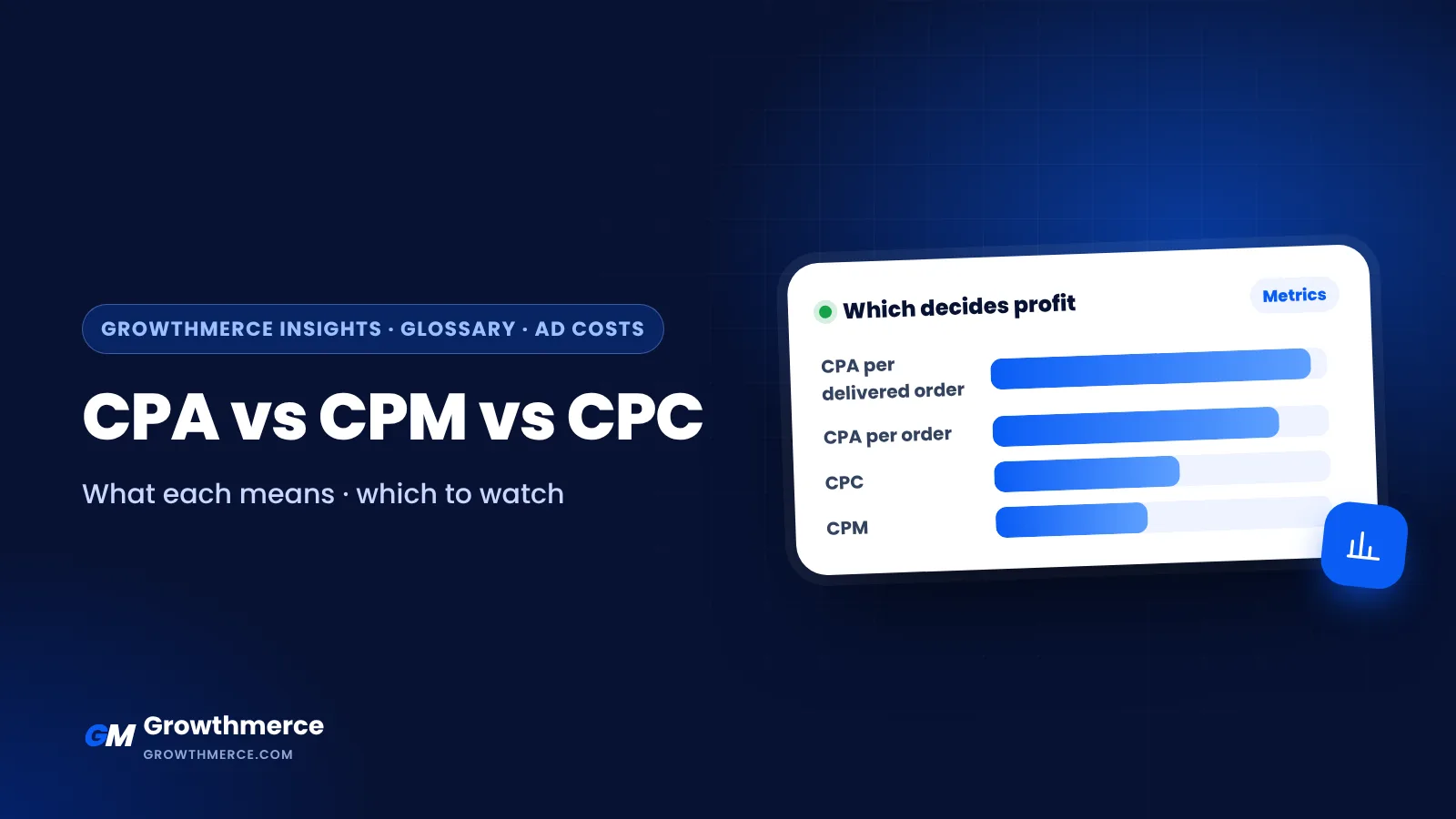
Short answer: CPM is what you pay for 1,000 ad impressions, CPC is what you pay per click, and CPA is what you pay per result such as an order or lead. CPM and CPC explain why results are cheap or expensive, but CPA, and for cash on delivery stores the cost per delivered order, is the number that decides profit. Growthmerce optimises campaigns on cost per delivered order and lead quality. See our packages or book a free call.
The three formulas
“`latex \text{CPM} = \frac{\text{Spend}}{\text{Impressions}} \times 1000 “`
“`latex \text{CPC} = \frac{\text{Spend}}{\text{Clicks}} “`
“`latex \text{CPA} = \frac{\text{Spend}}{\text{Conversions}} “`
A worked example
| Item | Example value |
|---|---|
| Spend | 5,000 EGP |
| Impressions | 250,000 |
| Clicks | 2,500 |
| Orders | 50 |
| CPM | 20 EGP |
| CPC | 2 EGP |
| CPA (cost per order) | 100 EGP |
The numbers are an example only.
How they connect
CPA depends on three things: how expensive it is to reach people (CPM), how many of them click (click-through rate) and how many visitors buy (conversion rate). A high CPA can come from any of the three.
Which metric to watch
- E-commerce: CPA per order, and cost per delivered order for COD.
- Lead generation: cost per qualified lead, not just per form fill.
- Awareness: CPM and reach.
Why CPM goes up
- Seasons like Ramadan and White Friday.
- Narrow audiences.
- Weak creatives with low engagement.
See how to diagnose high CPM on Meta.
How to lower each
- CPM: broader audiences, fresh creatives, avoid peak days when possible.
- CPC: stronger hooks and clearer offers.
- CPA: better landing pages, checkout and order confirmation. See conversion rate.